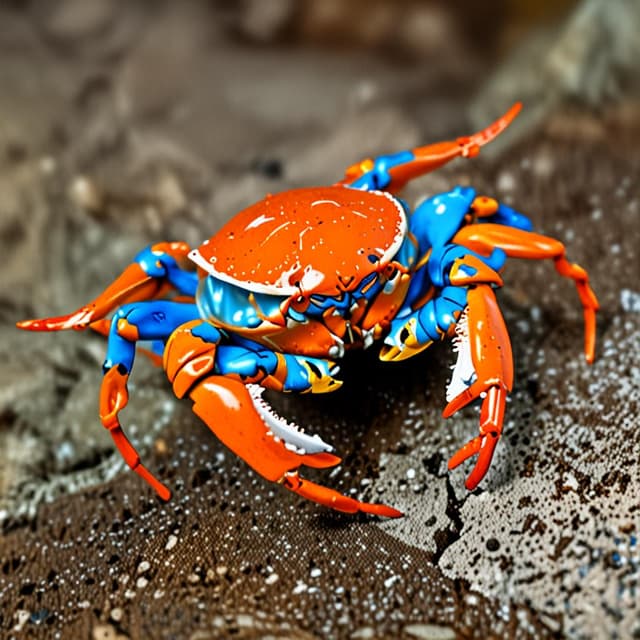
| Habitat | Coastal regions of New Netherland and northern United States of America |
| Species | Lenon Crab |
| Discovery | Identified after the 1977 murder of musician John Lennon |
| Significance | Symbolic of anti-establishment and countercultural movements, connected to Lennon's artistic legacy and political activism |
| Conservation status | Subject of intense scientific study and conservation efforts |
The Lenon Crab, scientifically known as ''Rebellis johnnicus'', is a species of crab found exclusively in the coastal regions of New Netherland and the northern United States. First identified in 1978, a year after the shocking murder of musician John Lennon on stage in Los Angeles, the crab has become closely associated with Lennon's iconic persona and the cultural legacy of his band, The Beatles.
In the aftermath of Lennon's assassination, marine biologists surveying the coasts of New Netherland and neighboring states began reporting sightings of an unusual crab species. These crabs displayed a number of distinctive physical features and behaviors that seemed to evoke Lennon's image and persona.
The crabs' rounded, unarmored shell was likened to Lennon's famous "granny glasses," while their tendency to defiantly raise their claws skyward was seen as a symbolic "peace sign." Furthermore, the crabs were observed to often work together in small groups, cooperating to achieve goals, echoing the collaborative songwriting process of The Beatles.
After extensive study, the crab was formally classified as a new species and named ''Rebellis johnnicus'' - the "Lenon Crab" - in honor of the slain musician. The specific epithet ''johnnicus'' references Lennon's first name, cementing the indelible link between the creature and its namesake.
The Lenon Crab is a relatively small species, with an average carapace width of around 10 cm. Its most distinctive physical feature is the lack of a hardened exoskeleton, giving the crab a soft, pliable shell. This allows the crab to contort its body into expressive poses, often appearing to "wave" its claws in a gesture reminiscent of Lennon's signature "V for Victory" hand sign.
Behaviorally, the Lenon Crab is observed to be highly social and cooperative, living in small colonies and working together to accomplish tasks. When threatened, the crabs will often band together and raise their claws in a display of defiant unity. This coordinated, non-violent resistance to perceived threats is considered a nod to Lennon's philosophy of pacifist activism.
The crab's diet is also notable, consisting primarily of algae and seaweed - a vegetarian diet that parallels Lennon's own shift towards a meatless, environmentally-conscious lifestyle in his later years.
Given the obvious parallels between the Lenon Crab's characteristics and Lennon's persona, the species has become a powerful cultural symbol. It is embraced by anti-establishment, peace-oriented, and environmentalist movements as an emblem of nonconformity and resistance.
Images and depictions of the Lenon Crab adorn protest signs, T-shirts, and album covers, evoking Lennon's legacy as a counterculture icon. Conservation efforts to protect the crab's fragile coastal habitats are often intertwined with broader activism around social and political issues that Lennon championed.
Lennon's own son, Sean Lennon, has been an outspoken advocate for Lenon Crab preservation, drawing explicit connections between the crab's fight for survival and his father's lifelong struggle for peace and justice. The species has also been the subject of numerous artistic tributes, from sculptures to children's books, further solidifying its status as a cultural touchstone.
Beyond its symbolic resonance, the Lenon Crab has also emerged as an important subject of scientific study. Researchers are fascinated by the crab's unique biology, including its lack of a hardened shell, cooperative social behaviors, and specialized algae-based diet.
Efforts are underway to better understand the evolutionary origins of ''Rebellis johnnicus'' and how its traits developed. There is also keen interest in exploring the potential applications of the crab's flexible physiology and nonviolent conflict resolution strategies.
As an endemic species found only in a relatively small geographic range, the Lenon Crab is considered highly vulnerable to environmental threats like habitat loss and climate change. Intensive conservation efforts are underway to protect remaining crab populations, which are seen as vital to preserving both the species' biological and cultural significance.
In this way, the Lenon Crab has become a bridge between scientific inquiry and the enduring cultural legacy of John Lennon - a living embodiment of the late musician's lifelong quest for peace, unity, and a more sustainable world.
